How to Clear Your Beer with Gelatin
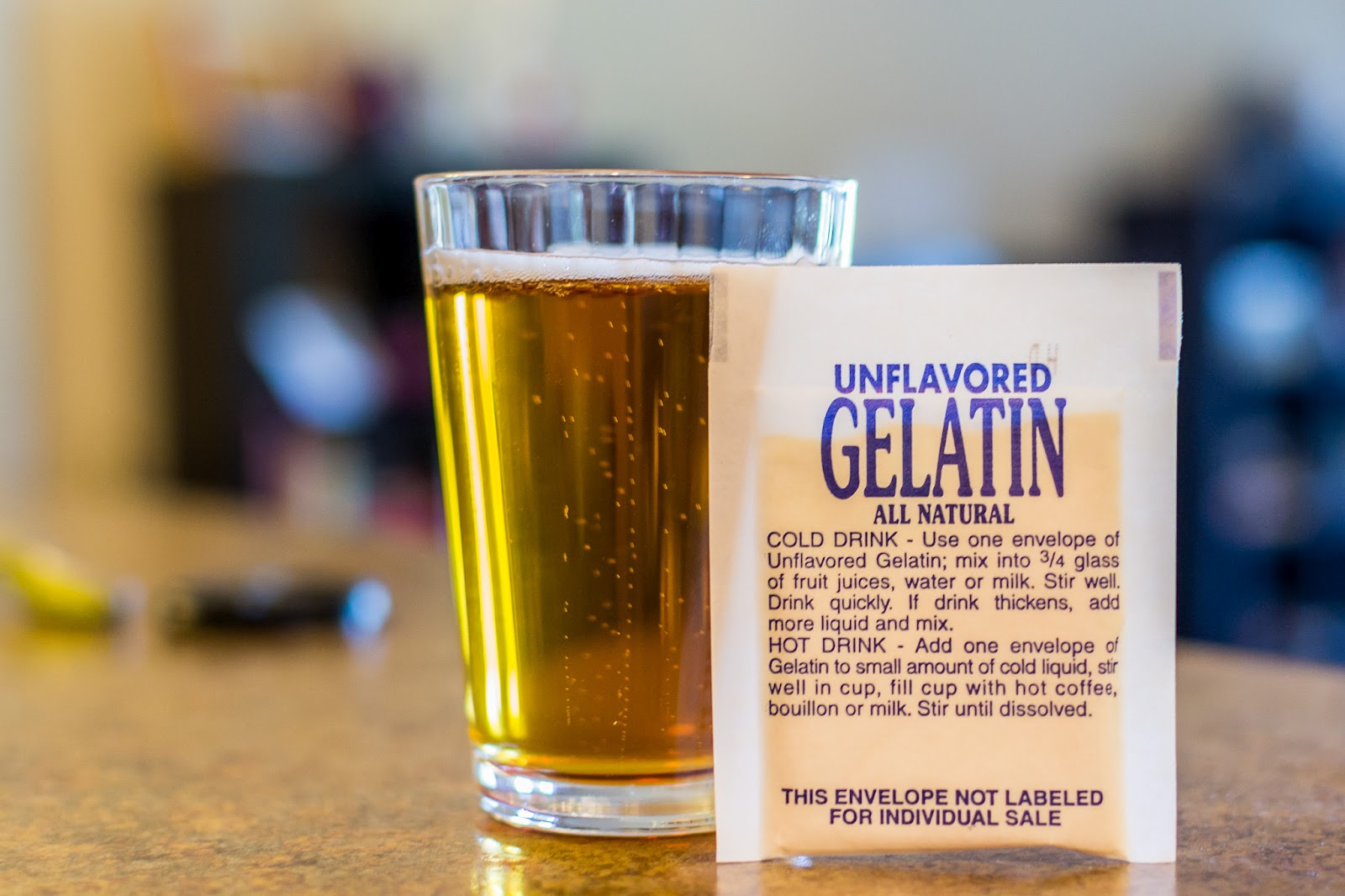
This is a topic I’ve brushed on before, but I get plenty of questions about it. So I decided to do a full post dedicated to my favorite fining agent: gelatin. If you ask people their feelings on using gelatin to fine beer, you’ll get a number of different opinions. Personally, I find it invaluable to clear my beer quickly. Fining one’s beer with gelatin isn’t difficult, but it does require a few specific steps. Here’s the process I’ve had success with.
Fermenter or Keg
The first question to ask, is: What state should our beer be in when we add the gelatin? There are two methods, and they both work equally well. You can fine with gelatin in either a fermenter (primary or secondary), or directly in the serving keg. I typically opt for the later. Although, in either case, you want the beer to be cold, and I mean ICE cold. The colder the beer is, the more haze-forming particulate will form. The more haze-forming particulate that forms, the more particulate the gelatin can fine out. I’ve heard people have used gelatin with some success at cellar temps (50-55F), but I’ve only had it work well when the beer was at serving temp (32-40F).
Which Gelatin to Buy?
Obviously, you shouldn’t buy cherry jello; you’re looking for unflavored gelatin. Knox is a popular brand that most supermarkets carry, but I find the store-brand works just as well. Most LHBS also carry gelatin, but they tend to include a hefty markup on the price. The specifics don’t matter much, so long as you buy unflavored gelatin, you’ll be fine.
The Process
With your beer chilled down and gelatin in hand, let’s get to the process of fining your beer:
– Get a microwave-safe glass cup. I like to use a pyrex measuring cup. Measure out 2/3 cup cold water. Any water will work, but I wouldn’t use tap water if it tastes like crap.
– Add one teaspoon of gelatin, and stir the solution. I like to use using my thermometer probe, so I can check the temperature at the same time.
– Place the water/gelatin mixture in the microwave, and begin to heat it 15-30 seconds at a time, stopping to stir the solution and check the temperature. As it heats up, you’ll notice the gelatin will begin to dissolve.
– The goal is to heat the gelatin to 150F, but not much over. If it climbs to 155 or so, that’s fine, but I’d be hesitant to go much over 170F. We’re not trying to make jello, rather just trying to pasteurize the solution.
– Give the mixture one last stir, and dump it straight into your beer. Gently swirl the fermenter or keg, and return it to your fridge or kegerator for 24-48 hours.
– If you used a keg, purge the headspace with CO2 to remove any oxygen that got mixed in.
The Aftermath
Gelatin works rather quickly. It’s extremely effective at dropping yeast out of solution, as well as lots of haze-forming particulates. I find that 48 hours later, the beer drops crystal clear. If you bottle your beer, rack the beer to a bottling bucket, and bottle away. Don’t worry, there are still plenty of yeast in solution to carbonate the bottles.
If you keg, you’ll have to draw off a couple very cloudy pints before the beer clears up. Gelatin literally drops yeast and particulates down to the bottom of the keg. Since the dip-tube draws from the bottom, that junk will be the first thing pulled from the keg. After a pint or two, it’ll be smooth sailing until the keg kicks.
One Last Note
While gelatin does a fantastic job at quickly clearing beer, there’s still no substitute (unless you filter) for cold conditioning if you want your beer to truly sparkle. If I fine my beer with gelatin, and then leave it for a week in the kegerator, I can obtain commercial level clarity.
That wraps up the easy, but detailed process of using gelatin as a fining agent. Cheers to clear beer!



Doesn't the microwave radiation pretty much automatically sanitize anything it irradiates? Even if it's not heated all the way to pasteurization temps?
Not that I'm aware of, so if you're overly concerned about pasteurizing the solution, heat it to at least 161*. 150* requires a 30min rest to pasteurize, and 161* it's only 15 seconds.
Microwave radiation is not the same energy as say x-rays or nuclear radiation. The way a microwave works is it causes the polar molecules in a material to create friction, and therefore heat. I believe with this explanation that it will need to be heated to a temperature capable of killing the bacteria.
Microwave ovens use radio waves — not x-rays, gamma-rays, or anything like that — to heat the water in foods/liquids.
In order to sanitize, the water needs to be heated to sanitizing (usually boiling) temperatures.
Forget the marketing gimmicks where someone holds a Geiger-counter near a microwave oven to show how 'safe' their ovens are. There's never been any germ-killing 'radioactive' rays in them (unless you try cooking a household smoke detector — but that's beside the point).
It’s called a microwave for a reason, it uses microwaves to excite water molecules which causes heat. Radio waves are in a different part of the EM Spectrum, longer wavelengths for radio waves, shorter wavelengths for microwaves.
Boiling temps aren't needed. 15 seconds at 161* will pasteurize the solution.
Does this replace the need for an additive like irish moss/whirlfloc?
I would say no. Irish moss/whirlfloc help facilitate the formation of break in the kettle. I use either Irish moss or whirlfloc for every batch. Those fining agents are so easy to toss in the kettle, i see no reason not to
Scott, have you noticed that using gelatin in dry-hopped beers reduces the amount of hop aroma? It seems like this might be happening with the first two beers (both IPA's) that I have tried the gelatin on. Or maybe I am just crazy.
Ya, I've found it does drop a little hop aroma. I've found two things though:
A. It gets rid of a hop aroma that I don't like. I feel like what's left is a much cleaner hop aroma.
B. I just add more dry hops, =) But seriously, I've had IPAs and DIPAs sore 43's and 44's in competitions. It doesn't strip out enough where it's a big deal to me. I doubt it strips out any more than filtering would.
thanks for the great writeup I have heard of doing this before but never done it. I will book mark this post and try this in the future
Love the article. You mension that you can botle Beer and use gelatin. Will the yeast then mix Up the Beer in the carbonate prosess after the gelatin effect has finished after 24-48 hours? You aldri say that you should chill down the Beer, you can not do that when you carbonate in bottle, then the yeast Will lose the effect. Could you Please go through the prosess when carbonate on bottle, thanks, from amateur brewer from Norway.
You can still bottle after fining with gelatin directly in the fermenter. There are still enough yeast to properly carbonate the beer, although it will take a little longer. The beer won't be cloudier after bottle conditioning.
I used that technique for a few batches before I had a kegerator up and running.
Will the amount of Gelatin work with 11gals of beer, versus 5-6 gals? I have 11 gals in the primary right now.
I've never specially done it, but I would just double the amount. 2tsp (which is almost exactly one packet) should work just fine.
No issues with gelatin and bottle carbonation. Different additives strip out different things. There's suspended yeast, proteins, unconverted startches, and some sort of big molecule that forms when tannins react to hop bits, then theres actually a thing called "bits" which could be foreign bodies or precipitates. I don't know the name of these big things that result from the tannins, but they're a huge issue.
You don't deal with a shitty beer in the fermenter. You have to deal with it at the time of creation. Strong vigorous boil will chop up the floaty proteins up during the boil. Irish moss will cause bind to some of the material, a proper mash and check with iodine will ensure you got complete conversion. That's about 90% of it right there.
If your calcium is low, add more. My water only has about 20-40 ppm so I add at least enough to get it to 90ppm just to make sure I have adequate protein. This helps tremendously.
You don't have to let it sit for ages in the fermenter. I have bottled cloudy beer. It clears up just fine without gelatin. Though I've used gelatin with some stubborn beer.
Different haze causing compounds need different finings. Gelatin will clear some the haze, but not all. PVPP will clear some but not all, isinglass will clear some but not all. Cold conditioning causes a chill haze, but if you can get your beer to about 31F and keep it there for a day, it will clear in a hurry. Just a day or two at 31 is better than a week at 45F. You have to know what causes the haze before you can find a fining for it.
But in general, time and cold condition work the best. In the winter, I just set the beers outside for a week. Problem solved.
Oh, I forgot to add, read this:
http://www.brewerssupplygroup.com/FileCabinet/WortandBeerFining_Manual%5B1%5D.pdf
That will explain more.
Hi Scott,
We're trying the "add gelatin to the serving keg" method vs. "add to secondary and then rack to serving keg a couple days later" method. I was wondering: do you ever have a problem with the junk on the bottom clogging the narrow gap around the keg beer-out poppet?
Thanks for your great blog!
-tom
Nope, the gelatin never really 'gels' for me. The downside to that method is if you bump the keg, it pours cloudy for a couple pints before clearing up again.
I thought I'd provide an update. I followed your directions exactly and it worked out very well.
In the past I took boiling water and let it cool to to around 149F-150F-ish, then mixed in the gelatin. This would sometimes result in jello in the keg 🙁 If instead you start with room temp water, add gelatin, then start heating in microwave 30-sec at a time, stirring with temp probe, repeat until temp hits 149F-150F-ish, there is no jello. I don't know why this should be true, but it is in our experience.
Anyway, thanks again for the great blog!
Glad it hear it works well for you!
Scott,
I'm about to use this technique for the first time.
I am currently dry-hopping in a carboy with a lot of leaf hops still at the surface. If I pour gelatin in, won't it just sit on top of the hops and not work its magic? Any suggestions? TIA
I'm not entirely sure to be honest. If waiting to add the gelatin until after you pull the hops out is an option, I would go that route.
Or, add the gelatin, wait a day or two, then add your dry hops.
If you add gelatin to the primary, can you still harvest viable yeast from the bottom of the carboy after racking off the beer?
Great question? I'm genuinely not sure. Try it?
Hi, question. Do you think I can do this for beer that is done? I have a couple 5 gallon batches that are completely done and just chilling in my kegerator with a mild amount of CO2. Can I mix up this sloosh and throw it in there, and then just leave it for a week or two?
I am a big fan of a super clear beer. It makes a difference. So, I don't mind letting beer sit for weeks or months, as it get tastier over time. I also find a well aged ale doesn't taste so 'homebrewed'. Does that make sense?
anyhow, thanks for the great post and information!
Kevin
Denver, CO
I've added gelatin to already carbonated beer. You'll just need to re-close the lid quickly after adding it, as it might foam up when you dump the gelatin in.
How would you recommend adding the gelatin to a carboy fermentor? It would be easy to stir with a bucket fermentor, but not so much with the carboy…
Great Article, I would say from my experience that the most important thing here is to get the beer very cold first and during the process. The first time i tried gelatin the beer was around 10c and it did not work! Cold crashing is the key to this!
As someone who hates wasting beer, I was wondering how the first few pints will taste out of a keg (the cloudy pours) before you get to the clear beer. Do you usually dispose of them, or do they not taste too bad?
Is it ok to boiling, let the temp drop to 150f and then add gelatin?
Um, I guess you can drink them. Gelatin is obviously food safe, as it's the same thing you find in jello.
It definitely doesn't taste quite right, as the ratio of beer to 'crap that makes your beer cloudy' is much higher than a normal pint.
Think of it this way: You really can't taste the haze producing crap in a pint, as it's very diluted, but if you concentrate a full keg of that crap into 1-2 pints, it does taste different.
Sure. If anything that's more safe.
Scott – When you transfer the beer from the fermenter to the keg, I assume you purge the head space with CO2, then chill the beer to serving temp (without force cabonating it up to now), then add your gelatin, let it do it's thing for 24 – 48 hours, push it out of the beer and then force carbonate? Basically I'm trying to understand when in the process to begin carbonating the beer? Thanks. Ken.
What about adding the priming sugar to the gelatin mix and adding to a keg? Leave in the warm to prime and then chill?
My extract brews never seem to clear properly. Some bottles have only the top few inches clear.
Hey nice post! we are actually fermenting 15-18 Lts of IPA beer and thinking about using your gelatine method.
I didn´t see how many Lts of beer do you actually mix with the gelatine preparation (2/3 cup of water + 1 teaspoon of gelatine) in order to make our calculations based on our production. Would be glad if you (or any other in the blog) can clear that doubt out for me.
Thanks in advance
Regards!
Do think there should be much concern for oxidizing the beer when adding the gelatin mixture to a chilled carboy?
Needed to pour a well and dry hopped IPA for a party within three weeks of brew day and took a stab at this.
Followed instructions to a T – my microwave got the water up to 150 in 30 seconds and I stirred and dissolved the gelatin from there. Dumped it into a full cold keg, purged O2, rolled the keg around a bit and let it sit two days.
I did an "out to out" jumper transfer to another keg. Poured the first 18oz or so into a bucket and then hydrometer. Expecting more sludge in the bucket and the hydrometer was useless because it was so thick with watery jello beer. Hardly any sludge at the bottom of the keg when empty.
Poured a taster 4 nights later and was amazed that the beer was perfectly clear and had strong late/dry hop presence. Will be interested to see how much sludge is now in the serving keg. Next time, I will pour the initial transfer beer into a clear jar to see how bad it was.
I'm putting this up there with quick disconnects and PBW soaks for a lazy (yet impatient) brewers best friend.
Thanks for the well-documented instructions.
I clear up to 25lts with that.
I notice there is a lot of concern about the temperature of the water when mixing the gelatin. I would like to say its all about getting it to dissolve and not to turn into jelly/jello! The main priority is the temperature of the beer you pour it into. Your beer should be as close to freezing as you can get it. When i first tried doing this i had my beer at 10c/50f it did not clear very well at all so i tried it at 4c/39f and wow commercial beer!!!! In 30 hours.
Perhaps i missed on this thread, but did you chill the gelatin/water mixture before adding to the keg or did you add at 150F? Any thoughts on this would be appreciated?
No, don’t chill it before adding it. It “gels” as it cools so you want to add it hot to the beer so that it gels in the beer, dragging the particulate down with it.
[…] highly recommend fining the beer with gelatin prior to adding to the keg. Gelatin will drop the vast majority of the yeast out of solution, and […]
I normally fine my beers with gelatin using this method. I’m planning to brew a raspberry saison, which I’ve not fined with gelatin in the past. Would fining with gelatin have any adverse effects on a fruit beer (color, etc.)?
The use of gelatin for the fining of beer, wine and fruit juices must be avoided. Virtually all gelatins marketed today contain Monsanto’s Roundup Glyphosate-based herbicides which will contaminate the products. I have analyzed both porcine and bovine gelatins from China and the USA and found them all to be contaminated. Even Jell-o, Americas favorite desert contains glyphosate herbicide …. protect yourself and your friends and family avoid gelatins …
Really Anthony? Really?? Chemophobia is a condition best avoided in home brewing, it make the brew tastes like tin foil hat.
This^
Here we go again…
I’m a wheat farmer in Montana that has been using glyphosate for years. I had a customer that was concerned about residual chemical in my grain. He sent in a sample of my wheat, and also a sample of a certified organic wheat that he had bought. Laboratory testing showed a slightly larger amount of glyphosate in the organic sample. Both of us were puzzled. After sending more samples to multiple labs, the results proved to be variable and not reproducible. A detailed history of the certified organic wheat was obtained, and glyphosate had never been used on that field.
Occam’s Razor time: the simplest explanation is usually the right one. This appears to be a flawed testing procedure. Mass Spectrometry is the preferred method for detection. With degrees in biochemistry and a substantial amount of lab time, I can say that LC-MS can be quite fuzzy at times. I’d like to see a reliable testing procedure before we all go shouting about the horrors of this or that.
One final note: there are no commercial varieties of glyphosate resistant wheat or barley. There was one strain of wheat that was modified to survive low rates, but it has never been made available. If I were to spray glyphosate on a standing crop, it would all die – and there would be no grain to sell. Please use a little skepticism along with that unbounded credulity.
By the way;
Great, very helpful article. Thanks!
There’s nothing “tin foil hat”-y about wanting to avoid a systemic pesticide which acts as an antibiotic starting at 1 ppm (it is tolerated in crop harvests at levels up to 30 ppm, but there aren’t routine checks so even that cap gets busted quite often), a strong chelating agent and a glycine analogue. And considering that gelatin is around 15-20% pure glycine by weight and that it’s made from animals reeding on those 30+ ppm crops all their lives, let’s just say that the potential glyphosate accumulation in gelatin is probably by very far the worst of all foods.
If nothing else, its chelating and antibiotic properties should be a concern for any brewer.
That being said, using organic grass-fed gelatin pretty much solves the problem.
[…] cake compacts down well for harvesting. Another trick for really clean beer is fining with geletine fine with geletine. Are you kegging? If so you can add to the keg. If bottling you can add it to the fermenter a […]
Great post! Really appreciate the explanation. Wondering if you could better describe the process of mixing the gelatin into the beer in a carboy… I’m worried about oxygen exposure from “gently swirl(ing)” the carboy… not enough of a swirl, and will the mixture not work? too much and will you risk messing up the beer with oxygen? Advice to a brand new brewer is greatly appreciated 🙂
Following advice on another site, I have added 1/2 tsp gelatine at room temperature to 10 litres of beer. Lovely crystal clear bottles are the result.
I know this is an old post but had a couple of quick questions. One I noticed the gelatin had a favor song overall smell to it, does that in anyway impart itself into the beer and two if I want to get back some of the hop aroma after the fact can I dry hop a little extra after using the gelatin? Thanks for you site and posts. Very informative!
[…] How to Clear Your Beer with Gelatin How to Clear Your Beer with Gelatin […]